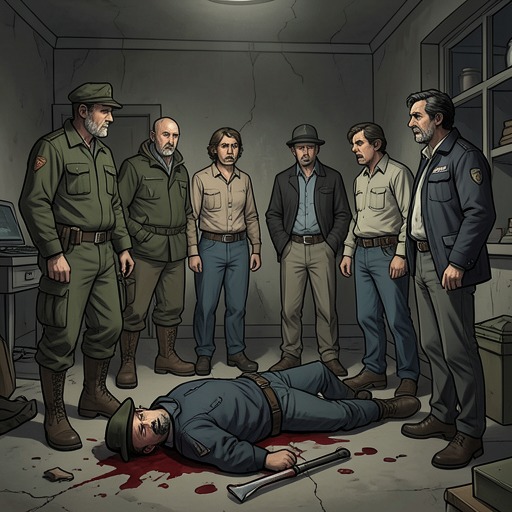
Damien Donnelly’s confession and arrest
In the WoodsDamien Donnelly’s confession and arrest turn Cassie Maddox’s long-standing profile of Katy Devlin’s killer into a pivotal interrogation strategy. Damien first acknowledges that killing Katy happened without his wanting it, then describes striking her with a rock; Rob Ryan formally arrests him on suspicion of murder. The scene presents confession as both a breakthrough and an incomplete account: later questioning reveals that Damien has withheld important details, complicating any easy equation between admission and full disclosure.
Background and Interview Strategy
Cassie has argued from the beginning that the killer was not a habitual violent offender who enjoyed causing pain, but someone who did not want to kill and believed he had no choice. Rob acknowledges that the other investigators had dismissed this interpretation, yet he and Cassie now use it to address Damien directly. Their approach gives him a possible identity other than that of a person defined by cruelty: a man who committed a terrible act and might be able to admit it.
The appeal is also calculated. Rob describes what can happen to people who commit violence and conceal it: fear, recurring distress, psychological collapse, or suicide. Cassie contrasts that life with the possibility of confessing, serving a prison sentence, and eventually living without constant fear of discovery. The investigators present confession as a route through consequences, not as a way to avoid them. Their argument is emotionally forceful, however, and the scene makes that pressure part of the circumstances in which Damien speaks.
The Admission
Asked quietly whether the description sounds familiar, Damien finally gives a small nod. He indicates that he does not want to live with the fear being described. Cassie touches his arm briefly, then withdraws her hand; the narration emphasizes that the gesture is restrained and not something that could be presented as coercion. She asks whether he wanted to kill Katy or whether it simply happened. Damien answers that it just happened.
The response marks the interview’s decisive turn. Until then, the detectives have been building a hypothetical account around Cassie’s profile; Damien’s answer connects that account to himself. His grip on a can has tightened until it buckles, and after his admission his hands go limp and the can falls onto the table. The narration registers the pause as a collective shock. Rob then identifies Damien by his full name and states the arrest: he is being arrested on suspicion that, on or around 17 August of that year, at Knocknaree in County Dublin, he murdered Katharine Bridget Devlin, contrary to common law.
Damien’s Account and Its Omissions
The confession develops beyond the initial admission. Damien recalls that Katy arrived earlier than expected, at approximately a quarter to one, carrying chocolate biscuits. She gave him one, which he put in his pocket without eating; she ate hers and spoke for a few minutes about ballet school. Damien says that he directed her to look at a shelf, then struck the back of her head with a rock. His account supplies a sequence of actions and a specific object, while his evident disbelief as he recounts the blow underscores the difference between describing what happened and seeming able to accept that he did it.
That account does not resolve every question. In later questioning, Rob challenges Damien for leaving out evidence concerning the archaeological trowel found in the tools shed. Rob points to the post-mortem photographs and findings, then confronts Damien with the further assault indicated by the evidence. Damien denies or resists the accusation, becomes distressed, and does not provide the motive Rob is seeking. The investigators therefore have a confession to killing Katy, but not a complete or uncontested account of the crime’s circumstances. The distinction matters: Damien’s first admission is a major investigative breakthrough, not a final explanation of everything that happened.
Arrest and Narrative Consequences
After the arrest, Damien continues to shake and refuses the practical comforts offered by the detectives, including fresh tea, an extra sweater, and reheated pizza. Rob remains fixed on him, reflecting on the personal and professional cost of the investigation: he has searched his own mind for memories, returned to Knocknaree wood, risked his career, and is losing his partner. The confession thus closes one immediate investigative question while leaving Rob’s private damage unresolved.
The scene also gives Cassie’s profile a qualified vindication. Her account of a reluctant killer helps open the way to Damien’s admission, but it does not establish that every part of his conduct was involuntary or explain the details he concealed. The later confrontation over the trowel resists a simple redemption narrative: remorse, fear, and a statement that the killing just happened coexist with evidence of further violence and continued evasion. Arrest makes the confession consequential in law and in the investigation, but the narrative preserves the gap between admitting responsibility and telling the whole truth.